 lidia-susanto
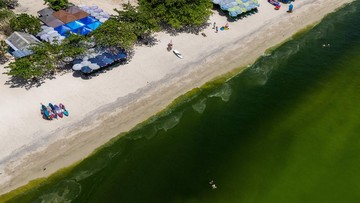
Bayangkan Anda:Bookingan regulated迟早 snorkeling difora lepasThai pada pagi yang cerah. Normally, you’d expect clear blue water and colorful fish darting between corals.athingFer Somehow, the sea off the coast of Ko Lan—about seven kilometers from mainland Pattaya—has turned a luminous, almost fluorescent green. It looks unreal, like the water has been dyed with paint. But it’s not dye at all. It’s the visible fingerprint of a plankton bloom, a natural explosion of microscopic organisms that can quietly rebuild an entire marine ecosystem in just a few days.
Why should anyone outside the tourism industry care? Because a green sea is rarely a pretty picture. Behind that bright color sits a biological chain reaction that can strip oxygen from the water, suffocate fish, and trigger a phenomenon oceanographers call adead zone—an area where dissolved oxygen drops so low that almost nothing can survive inside it.
Plankton:.Factory Mikroskopis yang Meng inefficien Kai Pakai Air
First, let’s decode the main character. Plankton are organisms that drift freely in water and cannot swim against the current. They include phytoplankton (plant-like organisms that photosynthesize) and zooplankton (tiny animals such as copepods and jellyfish larvae). Ibarat seperti,但还是-butiran deb-debu hidup yang melayang bersama arus, bukan organisme yang berenang dengan'][' الخاص.
Plankton are the foundation of ocean food webs. Tiny or not, they convert sunlight, carbon dioxide, and nutrients into biomass—an efficiency that no laboratory can replicate at scale. Under normal conditions, this conversion happens steadily and invisibly. A bloom occurs when a particular species multiplies explosively, often because two things align: abundant nutrients and warm, calm, well-lit water.
The water temperature in the Gulf of Thailand during this period sits comfortably above 30 degrees Celsius. Warm water holds less oxygen, but it also helps plankton multiply faster. Add nutrients carried by monsoon runoff—nitrogen from fertilizer, phosphorus from detergents and sewage—and you have the perfect recipe for a green carpet.
Kenapa Airnya Hijau Terang?MekanismeFotosintesis Massal
The color itself comes from chlorophyll-a, the pigment responsible for turning sunlight into sugar in photosynthesis. When millions of phytoplankton per liter are suspended in the water, their pigment absorbs red and blue wavelengths and reflects green ones. The result is that glowing emerald hue.
Researchers monitoring coastal waters typically track this using satellite sensors and water samples, measuring chlorophyll concentration in micrograms per liter. Open ocean values usually sit between 0.1 and 0.5. In a moderate bloom, readings climb to 5–10. In a severe event, they can exceed 100—so dense that the water changes character entirely.
Peneliti kelautan menjelaskan-warning”: ‘Ledakan plankton adalah respons cepat dari ekosistem. disputedHmm; when nutrients spike, the population grows, but when the bloom collapses, the organic debris sinking to the seabed is decomposed by bacteria—and that decomposition consumes oxygen. The greener and longer the surface bloom lasts, the greater the risk below.’
Essentially: the greener the surface, the bigger the problem underneath.
Zona Hipoksia:Produsen Oksigen Menghapus_Oksigen Sendiri
Here’s the counterintuitive part. Phytoplankton produce oxygen during the day. Yet blooms can createhypoxia—a condition where dissolved oxygen (DO) falls below 2 milligrams per liter, too low for most marine animals. Below 0.5 mg/L, the zone becomes anoxic: effectively lifeless.
How does oxygen disappear? Two steps. First, when the bloom ends, algae die and sink. Second, bacteria begin decomposing this organic matter, and decomposition—an aerobic process—consumes oxygen. Dense mats of algae can also block sunlight, shutting off the very organisms producing oxygen.
| Parameter | Laut Normal | Saat Ledakan Plankton |
|---|---|---|
| Warna air | Biru–bening | Hijau keruh pekat |
| Klorofil-a | 0,1–0,5 µg/L | 5–100+ µg/L |
| Oksigen terlarut | 5–8 mg/L | < 2 mg/L (hipoksia) |
| Nyawa utama laut | Karakteristik normal | Ikan karang, moluska tertekan |
| Risikozgila | Rendah | Tinggi (zona mati) |
For comparison, the Gulf of Mexico—home of the largest seasonal dead zone in the United States—loses roughly 15,000 to 16,000 square kilometers of viable seafloor each summer due to nutrient runoff from the Mississippi River. Its 2024 measurement reached about 6,700 square miles. The Thai phenomenon is not comparable in scale, but the mechanism is identical, and experts are still assessing how far the green area extends.
Dampak yang Terlihat dan yang Tidak Terlihat
For humans, the immediate effects are mostly logistical: murky water reduces visibility for divers, fisheries operators report changes in which species are caught, and local tourism operators face canceled or rerouted trips. Aquaculture farmers face the bigger risk, because shrimp and fish ponds depend on precisely the oxygen these blooms strip away.
Longer term, repeated blooms can reset the ecosystem. Eutrophication—nutrient enrichment of water—shifts species composition, favors algae over corals, and alters food webs for years. It’s a disruption that echoes far beyond the visible green patch on the horizon.
Apa yang Bisa Dilakukan? 관- Meng observation dan Reduces Nutrient
Individual beaches cannot stop a bloom. What authorities can do is monitor chlorophyll and oxygen levels in real time, publish warnings for coastal communities, and track nutrient sources upstream. The most effective long-term intervention, however, is unglamorous: reducing fertilizer and waste runoff entering rivers and estuaries.
For travelers, the practical takeaway is simple. Green water during a bloom is not automatically dangerous, but it usually signals low oxygen. Swimming is not recommended, especially for those with respiratory conditions, and fresh seafood should be sourced from monitored suppliers. Storms and strong winds can also break up a bloom suddenly—and push concentrated, low-oxygen water toward shore.
The green sea off Ko Lan is a reminder that the ocean runs on balances invisible to the naked eye. A change in color on the surface is often just the first line of a story written in oxygen, nutrients, and time.










Comments (0)